The Ashtavinayak Yatra is one of those journeys that I have encountered partly through my own experience and partly through my spouse’s. My spouse has completed the full Ashtavinayak circuit, visiting all eight temples, while I have had darshan at three of them — Chintamani at Theur, Mahaganapati at Ranjangaon and Varadvinayak at Mahad.
So I am writing about the Ashtavinayak not as someone who has personally completed the entire pilgrimage, but from the perspective of someone who has experienced a few of these temples and heard about the complete circuit through my spouse. What makes the journey interesting to me is the combination of familiar devotion, local traditions, temple architecture and the stories associated with each form of Ganesha.
The Ashtavinayak Yatra
The name Ashtavinayak literally refers to the eight forms of Vinayaka, or Ganesha. The traditional pilgrimage connects eight temples in Maharashtra, most of them within the wider region around Pune, with two located further west in Raigad district. Each temple has its own tradition, its own local setting and its own story associated with the form of Ganesha worshipped there.
For a devotee completing the traditional circuit, the journey is more than simply ticking eight temples off a list. The route moves through towns, villages, fields, hills and different parts of Maharashtra, making the physical journey part of the experience. My spouse’s completion of the circuit gave me a much better appreciation of how different the eight locations are, even though they are connected by a single pilgrimage tradition.
The Eight Ashtavinayak Temples
The eight temples are traditionally visited in a particular sequence. The journey begins at Morgaon and, after visiting the other temples, returns to Morgaon. Each shrine is associated with a different name and form of Ganesha and with stories that have been preserved through the Puranic and regional traditions surrounding these temples.
1. Moreshwar, Morgaon
The Moreshwar Temple at Morgaon is traditionally regarded as the beginning and the end of the Ashtavinayak pilgrimage. The temple is associated with the story of Ganesha’s victory over the demon Sindhu. The name Moreshwar is itself connected with the peacock, or mayura, and the traditions surrounding this form of Ganesha.
Although I have not yet completed the full circuit myself, Morgaon naturally occupies an important place in any discussion of the Ashtavinayak Yatra. For someone undertaking the complete pilgrimage, this is where the circuit comes together — beginning here and eventually returning to the same shrine.
2. Siddhivinayak, Siddhatek
The second temple is Siddhivinayak at Siddhatek. Here Ganesha is worshipped as Siddhivinayak, a form associated with the granting of siddhi, or accomplishment. The temple stands on the banks of the Bhima River and is one of the important stops on the traditional circuit.
Siddhatek is also a reminder that the Ashtavinayak temples are not all located in similar surroundings. The changing landscape and the journeys between the shrines are an integral part of experiencing the circuit.
3. Ballaleshwar, Pali
The Ballaleshwar Temple at Pali is unusual in that Ganesha is worshipped here in the name of his devotee, Ballala. The story tells of a young devotee whose devotion to Ganesha was stronger than the opposition he faced from his father. Ganesha is said to have appeared before him and remained at the place in the form of Ballaleshwar.
Pali is one of the two Ashtavinayak destinations in Raigad district. It also gives the pilgrimage a distinctly different geographical character from the temples closer to Pune.
4. Varadvinayak, Mahad
Varadvinayak at Mahad is the third Ashtavinayak temple I have personally visited. Having darshan here made the Ashtavinayak tradition feel less like a list of famous temples and more like a connected landscape of shrines that I could actually begin to relate to through my own experience.
The name Varadvinayak refers to Ganesha as the giver of boons. The temple is also connected with traditions involving the sage Grutsamad and, in the broader mythology associated with the site, the story of Vishnu and the demons Madhu and Kaitabha.
5. Chintamani, Theur
Chintamani at Theur is another temple where I have personally had darshan. Theur is relatively close to Pune, and the temple’s association with the story of the Chintamani gem gives this form of Ganesha its distinctive identity.
The traditional story concerns the sage Kapila and the precious Chintamani gem. When the gem is taken from him, Ganesha eventually intervenes and restores it to the sage. The story has therefore become associated with Ganesha as Chintamani, the one who brings peace to a troubled or restless mind.
6. Girijatmaj, Lenyadri
The Girijatmaj Temple at Lenyadri is perhaps the most visually distinctive of the eight. Unlike a conventional standalone temple, it is located within a rock-cut cave complex. The setting connects the shrine with the ancient rock-cut architecture of the region.
Girijatmaj is associated with Parvati, or Girija, and the tradition that Ganesha was born here. For anyone completing the Ashtavinayak circuit, Lenyadri is therefore not merely another stop on the route; the cave setting gives the visit a character very different from the other temples.
7. Vighneshwar, Ozar
At Ozar, Ganesha is worshipped as Vighneshwar, the remover of obstacles. The temple is associated with the story of Vighnasura, a demon whose activities created difficulties for the gods and devotees. Ganesha’s victory over Vighnasura is remembered through this form of the deity.
The idea of Ganesha as the remover of vighnas, or obstacles, is probably one of the most familiar aspects of his worship. At Ozar, that familiar idea is given a particular place, story and temple tradition within the Ashtavinayak circuit.
8. Mahaganapati, Ranjangaon
The other Ashtavinayak temple where I have personally had darshan is Mahaganapati at Ranjangaon. The temple is traditionally associated with the story of Shiva’s battle against Tripurasura, with Ganesha being invoked before the battle.
Ranjangaon is also significant to me because it is one of the three Ashtavinayak shrines I have personally visited. When I think about the complete circuit, therefore, I have my own memories of Theur, Ranjangaon and Mahad, while my spouse’s experience provides the perspective of someone who has actually travelled through all eight.
Our Connection with the Ashtavinayak
This distinction is worth mentioning because pilgrimage is often described in very general terms. In our case, the Ashtavinayak is not simply something we have read about. My spouse has completed the traditional circuit, while my own connection is through three of the eight temples — Theur, Ranjangaon and Mahad.
That also means that there are five temples I still have to visit if I ever decide to complete the circuit myself. Morgaon, Siddhatek, Pali, Lenyadri and Ozar remain on that unfinished part of my own Ashtavinayak journey.
Perhaps that is one of the interesting things about pilgrimage. A journey does not necessarily have to be complete before it becomes meaningful. Sometimes a few visits become the starting point for wanting to understand the larger tradition, the stories behind the shrines and the routes that connect them.
More Than Eight Temples
What interests me about the Ashtavinayak tradition is precisely this combination. The eight shrines are places of worship, but they are also part of the cultural landscape of Maharashtra. Their stories have survived because they continue to be told, visited and remembered rather than remaining confined to old texts.
There is also a strong connection between these stories and the wider storytelling traditions that interest us at GaathaStory. A story about Ganesha, a devotee, a demon, a sage or a king is not merely an isolated myth. It becomes part of the way communities remember places and explain why a particular deity is worshipped in a particular form at a particular location.
That is one reason I find the Ashtavinayak Yatra worth exploring beyond the question of whether one is undertaking the pilgrimage for religious reasons. The temples offer a way into Maharashtra’s mythology, geography, architecture and living traditions, all through a journey that has been followed by generations of devotees.
The Ashtavinayak Circuit
The eight traditional shrines are spread across Maharashtra rather than concentrated in one town. Starting at Morgaon, the circuit traditionally takes devotees to Siddhatek, Pali, Mahad, Theur, Lenyadri, Ozar and Ranjangaon before returning to Morgaon.
- Moreshwar — Morgaon
- Siddhivinayak — Siddhatek
- Ballaleshwar — Pali
- Varadvinayak — Mahad
- Chintamani — Theur
- Girijatmaj — Lenyadri
- Vighneshwar — Ozar
- Mahaganapati — Ranjangaon
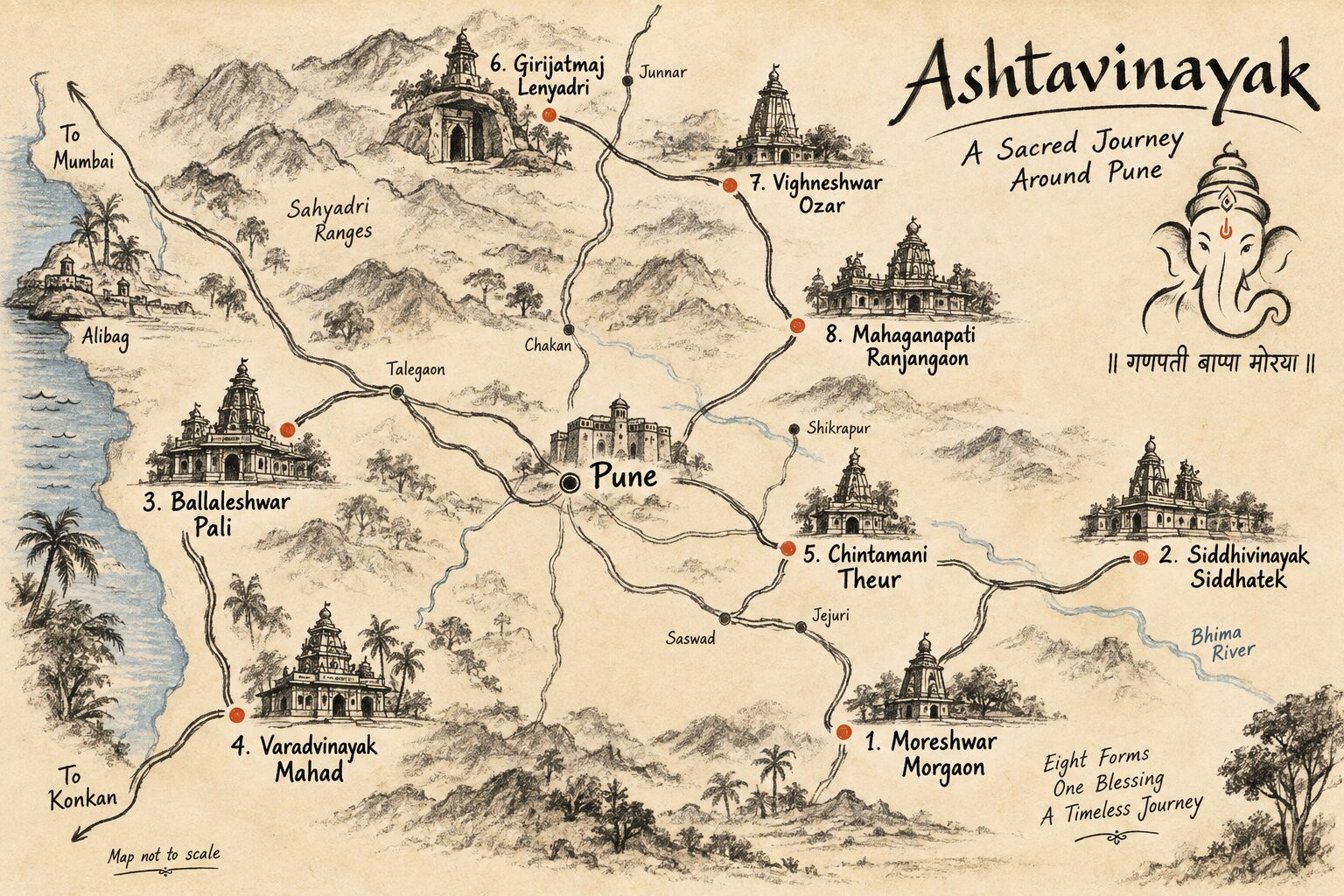
The map is deliberately not intended to be a navigation map or to scale. Its purpose is simply to show how the eight shrines sit in relation to Pune and to give a visual sense of the journey.
A Journey I Have Only Partly Made
For my spouse, the Ashtavinayak Yatra is a completed circuit. For me, it is still an incomplete journey, although three of the eight temples — Theur, Ranjangaon and Mahad — are already part of my own experience.
I like that distinction. Rather than presenting the Ashtavinayak as an abstract list of eight famous temples, it gives me a personal reason to return to the subject. Three shrines I have seen, five still to visit, and a tradition that connects all eight through stories of Ganesha, devotion and the places where those stories are remembered.
Perhaps one day I will complete the remaining five. Until then, the Ashtavinayak Yatra remains both a pilgrimage I have partly experienced and a journey I can still look forward to completing.
Frequently Asked Questions
What is the Ashtavinayak Yatra?
The Ashtavinayak Yatra is a traditional pilgrimage connecting eight temples dedicated to different forms of Lord Ganesha in Maharashtra.
Which are the eight Ashtavinayak temples?
The eight temples are Moreshwar at Morgaon, Siddhivinayak at Siddhatek, Ballaleshwar at Pali, Varadvinayak at Mahad, Chintamani at Theur, Girijatmaj at Lenyadri, Vighneshwar at Ozar and Mahaganapati at Ranjangaon.
Have you completed the Ashtavinayak Yatra?
I have not completed the full circuit. My spouse has completed the Ashtavinayak Yatra, while I have personally had darshan at Theur, Ranjangaon and Mahad.
Where does the traditional Ashtavinayak circuit begin?
The traditional circuit begins at Moreshwar Temple in Morgaon and concludes with a return to Morgaon after visiting the other seven temples.
Also Read
Discover more stories from GaathaStory, including Devgatha, Veergatha, Parikatha and Baalgatha.
Have you completed the Ashtavinayak Yatra? Share which of the eight temples you have visited, and which one left the strongest impression on you.