The six Ganapati temples of Coastal Karnataka have been on my radar for several years, partly because of their resemblance to Maharashtra’s Ashtavinayak tradition and partly because they are spread across a beautiful stretch of the Karnataka coast. My own journey through these temples has happened in stages rather than as one continuous pilgrimage. In January 2018, I had darshan at three of them — Anegudde Sri Vinayaka, Hattiangadi Siddhi Vinayaka and Sharavu Mahaganapathi — and in December 2021, I visited Idagunji Vinayaka and Gokarna Mahaganapati.
That leaves just one temple on my list: Madhur Maha Ganapathi Temple, near Kasaragode on the Kerala-Karnataka border. So, although I have visited five of the six temples, I cannot quite claim to have completed the entire circuit. This is therefore a personal account of a journey that is mostly complete, with one more darshan still waiting to happen.
The Six Ganapati Mandirs of Coastal Karnataka
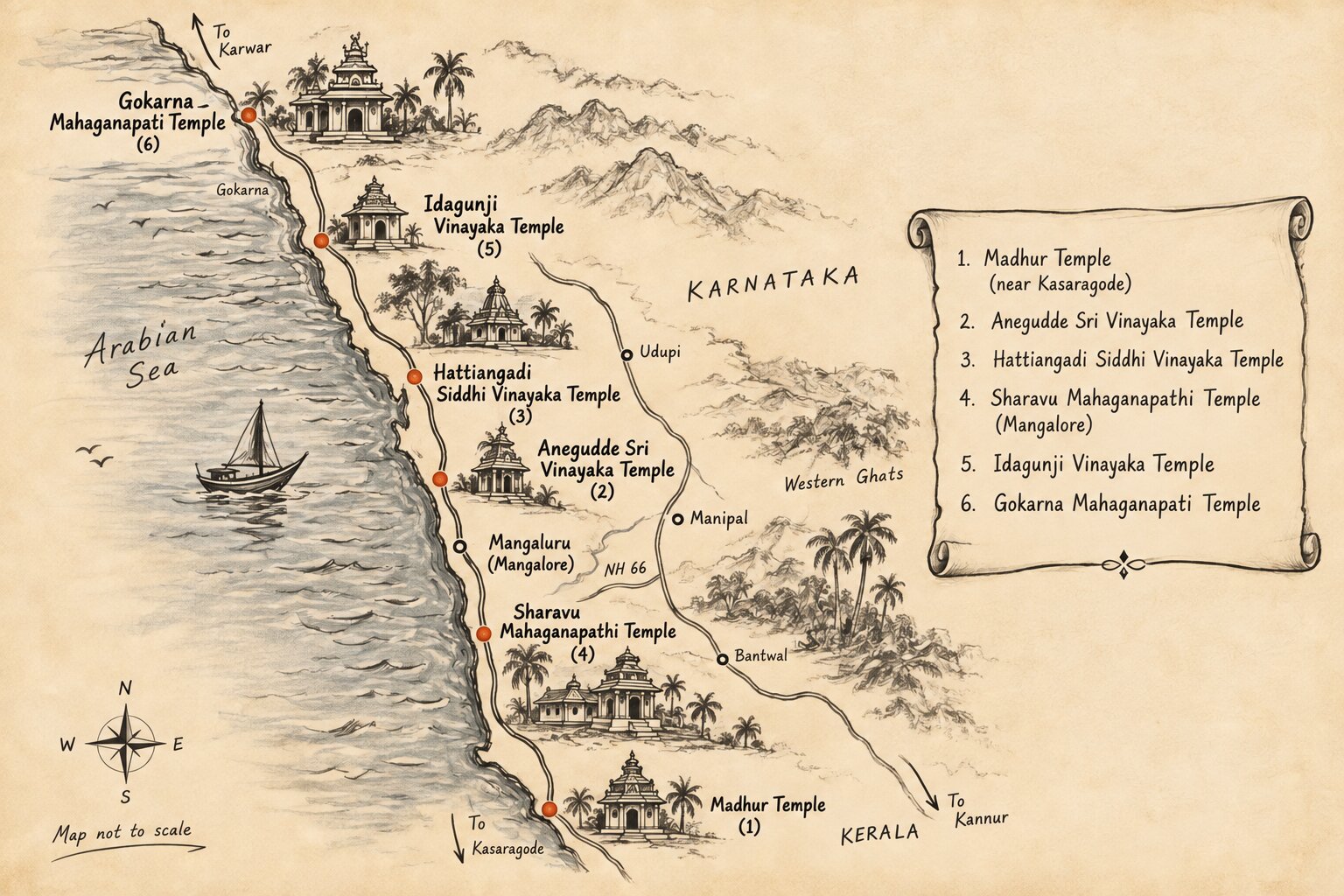
Coastal Karnataka has a remarkable concentration of temples associated with Ganesha, each with its own local tradition and story. The six temples commonly included in this coastal pilgrimage are Madhur, Anegudde, Hattiangadi, Sharavu, Idagunji and Gokarna. They are not identical in character: some are ancient temple complexes, some are closely connected with local legends, and some occupy settings that make the journey itself memorable.
I find the comparison with Maharashtra’s Ashtavinayak pilgrimage particularly interesting. I would not describe the six temples as a formal equivalent of the Ashtavinayak Yatra, but there is certainly a similarity in the idea of visiting several important Ganesha shrines spread across a region. In both cases, the temples become a way of connecting mythology, geography, architecture and living traditions.
23 January 2018: Three Ganapati Darshans
My first three visits happened in January 2018. On that journey, I had darshan at Anegudde Sri Vinayaka Temple, Hattiangadi Siddhi Vinayaka Temple and Sharavu Mahaganapathi Temple. Looking back, I realise that these three visits gave me a useful introduction to the variety of Ganapati worship along the coast, from temple towns and village settings to a shrine located right in the middle of Mangalore.
Anegudde Sri Vinayaka Temple
Anegudde Sri Vinayaka Temple, near Udupi, was one of the three temples I visited in January 2018. Anegudde is associated with the worship of Vinayaka as Vighnaraja, the remover of obstacles, and the temple is traditionally regarded as one of Karnataka’s important pilgrimage centres. The setting itself adds to the experience. The temple stands on a hill surrounded by the landscape of coastal Karnataka, making the visit feel quite different from visiting an urban temple. Traditions associated with the temple also describe the idol as swayambhu, or self-manifested, which is an important part of the shrine’s religious significance.
Hattiangadi Siddhi Vinayaka Temple
The second temple I visited that day was Hattiangadi Siddhi Vinayaka Temple in Udupi district. The temple has a long history associated with the Alupa period, and its granite Ganesha idol is traditionally described as having the trunk turned towards the left, or edamuri. For me, Hattiangadi was another reminder that these temples cannot really be understood just by looking at a list of names. Their locations, architecture, local traditions and the stories surrounding the deities are all part of the experience. Travelling between the temples also creates a sense of continuity between otherwise very different places.
Sharavu Mahaganapathi Temple, Mangalore
The third temple of that January 2018 journey was Sharavu Mahaganapathi Temple, located in the heart of Mangalore. Unlike the more rural or hill settings of Anegudde and Hattiangadi, Sharavu is very much part of an active city environment. The temple is deeply connected with Mangalore’s religious and cultural life. Sharavu Mahaganapathi is traditionally associated with King Vira Narasimha Bangaraja and is worshipped as a powerful form of Ganesha. The temple’s annual celebrations, including the Rathotsava, are an important part of the local festive calendar. Having darshan here completed my first set of three temples.
December 2021: Two More Darshans
Three years later, in December 2021, I added two more temples to the list: Idagunji Vinayaka Temple and Gokarna Mahaganapati Temple. These visits were not part of the same journey as my 2018 visits, but together they brought me much closer to having seen all six of the temples associated with this coastal Ganapati tradition.
Idagunji Vinayaka Temple
Idagunji Vinayaka Temple is one of the best-known Ganesha shrines on the Karnataka coast. The temple is traditionally associated with a long history of worship, and devotees come here seeking the blessings of Idagunji Ganesha, who is also associated with success and prosperity. One feature that makes the shrine particularly interesting is the form of the idol. Ganesha is depicted standing, which is relatively unusual and gives the deity at Idagunji a distinctive appearance. I had darshan here in December 2021, finally adding the fifth temple to my personal list.
Gokarna Mahaganapati Temple
The other temple I visited in December 2021 was Gokarna Mahaganapati Temple. Gokarna is already one of the best-known pilgrimage destinations on the Karnataka coast, and the Mahaganapati shrine is closely associated with the famous story of Ganesha and Ravana. The Gokarna tradition gives Ganesha an important role in the story of the Atma Linga. The temple is therefore interesting not only as one of the six coastal Ganapati shrines but also because it connects Ganesha with one of the best-known sacred legends associated with Gokarna.
The One Temple I Still Have to Visit: Madhur
There is now only one temple left for me: Madhur Maha Ganapathi Temple, near Kasaragode, close to the Kerala-Karnataka border. I have not yet had darshan there, so I would rather leave that part of the story unfinished than pretend that I have completed the six-temple journey. Madhur is traditionally associated with Maha Ganapathi and is known for its distinctive temple architecture and legends. One of the traditions associated with the shrine says that it was originally connected with Shiva worship before the appearance of Ganesha became central to the temple’s identity.
Perhaps there is something appropriate about having one temple still left. It gives me a reason to return to this part of Karnataka and complete what began with those three visits in January 2018 and continued with two more in December 2021.
The Six Temples at a Glance
- Madhur Maha Ganapathi Temple — near Kasaragode, Kerala-Karnataka border — yet to visit
- Anegudde Sri Vinayaka Temple — near Udupi — darshan, January 2018
- Hattiangadi Siddhi Vinayaka Temple — Udupi district — darshan, January 2018
- Sharavu Mahaganapathi Temple — Mangalore — darshan, January 2018
- Idagunji Vinayaka Temple — Idagunji — darshan, December 2021
- Gokarna Mahaganapati Temple — Gokarna — darshan, December 2021
A Ganapati Journey Along the Coast
One of the things I appreciate about these temples is that they make it difficult to separate the pilgrimage from the landscape. The journey takes one through coastal towns, villages, stretches of the Western Ghats and the larger pilgrimage centres of places such as Udupi, Mangalore and Gokarna. The temples are therefore connected not only by their association with Ganesha but also by the geography through which one travels to reach them.
There is also considerable variety in the stories associated with the six shrines. Some involve devotees and the removal of obstacles, others connect Ganesha with Shiva, Ravana or other figures from Hindu mythology. These stories are part of a larger tradition in which temples are not simply buildings where rituals take place; they are places where stories, memories and local traditions continue to be carried forward.
The Connection with Maharashtra’s Ashtavinayak
The comparison with Maharashtra’s Ashtavinayak Yatra is one of the reasons I became interested in documenting these six temples. The two traditions are not the same, but there is an obvious point of connection: devotees travel between several important Ganesha shrines, each with its own form, legend and local history. I have had darshan at three of the Ashtavinayak temples myself — Theur, Ranjangaon and Mahad — while my spouse has completed the entire Ashtavinayak circuit. In that sense, the two traditions have become personal journeys for both of us, although neither journey happened as one single continuous pilgrimage.
What I find particularly interesting is how the same deity can acquire such different identities in different places. A Ganesha temple in Maharashtra and a Ganesha temple on the Karnataka coast may both evoke the same familiar deity, yet their stories, architecture, landscape and local customs give each shrine its own character.
Planning a Visit to the Six Ganapati Temples
If I were planning the complete journey now, I would treat it as a road trip rather than simply a temple checklist. The six shrines are spread over a considerable stretch of the coast and adjoining region, so travel time matters. Depending on the starting point and how much time one wants to spend at each temple, it would make sense to allow several days rather than rushing from one darshan to the next.
The cooler months are generally more comfortable for travelling through Coastal Karnataka, particularly if the journey involves several road trips. It is also worth checking individual temple timings, festival dates and local arrangements before setting out, because darshan conditions can change during major festivals and special occasions. For me, the most logical next step is rather simple: visit Madhur. Once I have had darshan there, I will finally be able to say that I have personally visited all six temples discussed in this article.
Five Darshans Down, One to Go
My connection with these six Ganapati temples has unfolded over several years. Three darshans on 23 January 2018 — Anegudde, Hattiangadi and Sharavu — were followed by two more in December 2021 at Idagunji and Gokarna. Only Madhur remains. That makes this less a story about completing a pilgrimage and more a record of one that is still in progress. I have seen five of the six temples, travelled through different parts of Coastal Karnataka, and encountered the stories and traditions associated with each shrine. One day, when I finally make that journey to Madhur, I will be able to return to this article and add the sixth darshan.
Until then, the six Ganapati temples of Coastal Karnataka remain for me a fascinating thread running along the western coast — connecting Ganesha worship with mythology, architecture, landscape and the journeys that bring devotees to these sacred places.
Frequently Asked Questions
Which are the six Ganapati temples of Coastal Karnataka?
The six temples discussed here are Madhur Maha Ganapathi Temple, Anegudde Sri Vinayaka Temple, Hattiangadi Siddhi Vinayaka Temple, Sharavu Mahaganapathi Temple, Idagunji Vinayaka Temple and Gokarna Mahaganapati Temple.
How many of these temples have you personally visited?
I have had darshan at five of the six temples. I visited Anegudde, Hattiangadi and Sharavu on 23 January 2018, followed by Idagunji and Gokarna in December 2021. Madhur is the only temple I am yet to visit.
Are these six temples the same as the Ashtavinayak temples?
No. The six Ganapati temples of Coastal Karnataka and Maharashtra’s Ashtavinayak are separate pilgrimage traditions. They are comparable in the sense that both involve visiting important Ganesha shrines associated with different forms, legends and local traditions.
Which Ganapati temple is still left for you to visit?
Madhur Maha Ganapathi Temple, near Kasaragode on the Kerala-Karnataka border, is the only one of the six where I am yet to have darshan.
Also Read
Explore more stories from GaathaStory about Indian mythology, temples, saints, festivals and pilgrimage traditions.
Have you visited any of these six Ganapati temples? Share your experience and tell us which temple made the strongest impression on you.
Last updated: September 20, 2026 at 6:47 am