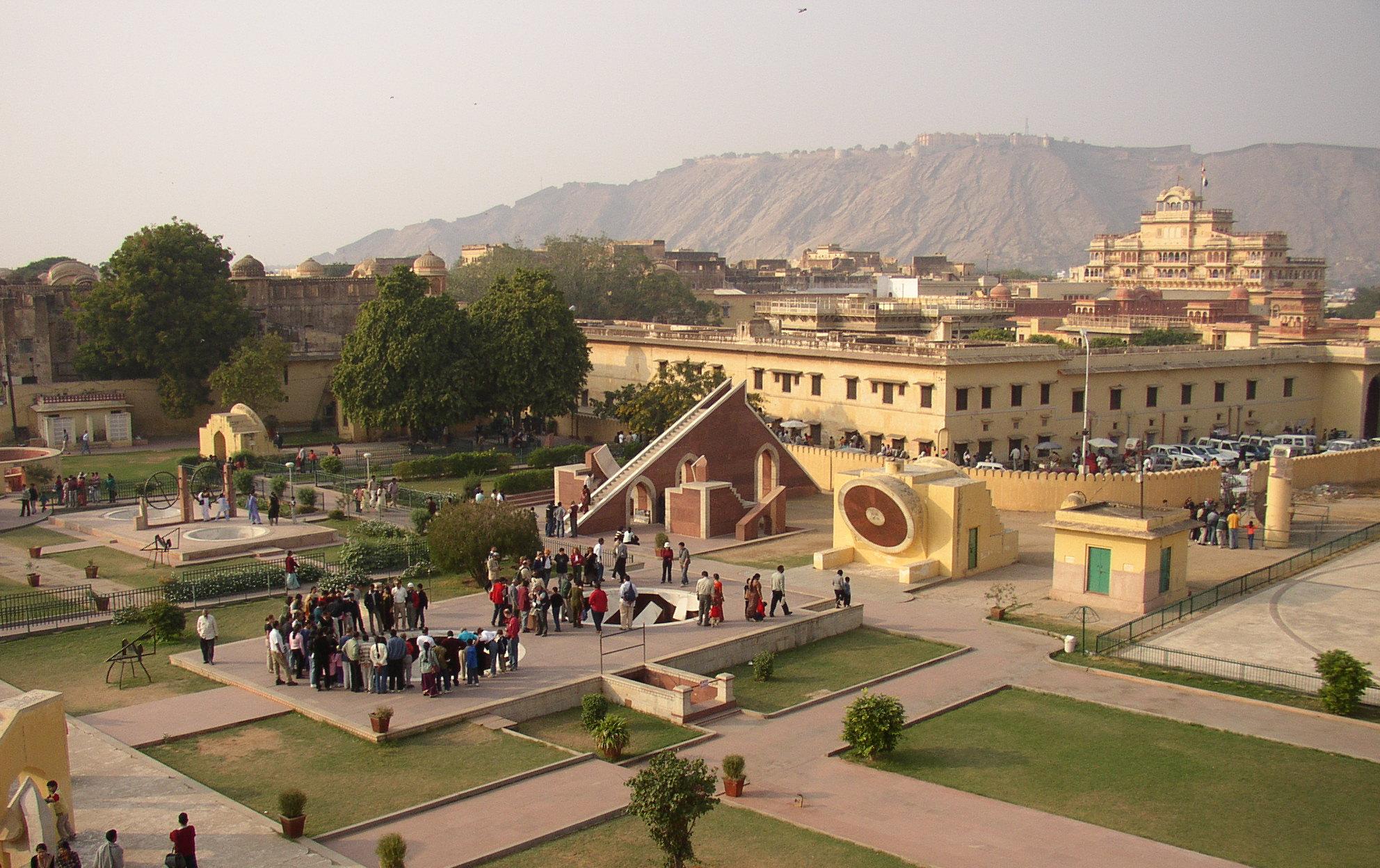
In this post, we discuss the network of Jantar Mantars by Sawai Jai Singh II (1688–1743) the ruler of Amber and founder of Jaipur, who commissioned five open-air observatories of brick, plaster, and marble between 1724 and the late 1730s.
Maharaja Sawai Jai Singh II of Amber built five large masonry observatories—Delhi (1724), Jaipur (largest, 1728–1734, UNESCO 2010), Ujjain (~1725), Varanasi (1737), and Mathura (destroyed before 1857)—to replace inaccurate brass instruments and compile better astronomical tables (Zij-i Muhammad Shahi). Sites were selected for scientific cross-verification and because they carried political, religious, and astrological weight. Jaipur’s Samrat Yantra can still measure local time to about two seconds.
महाराजा सवाई जय सिंह द्वितीय ने 1724 से लगभग 1738 के बीच पाँच जंतर मंतर बनवाए—दिल्ली, जयपुर (सबसे बड़ा, यूनेस्को विश्व धरोहर), उज्जैन, वाराणसी और मथुरा (1857 से पहले नष्ट)। चार आज भी मौजूद हैं। स्थान वैज्ञानिक सत्यापन और प्राचीन ज्योतिष-खगोल परंपरा दोनों के लिए चुने गए थे। जयपुर का सम्राट यंत्र आज भी लगभग दो सेकंड की सटीकता से समय बताता है।
About the Jantar Mantars
The five sites:
- Delhi (1724) — First and still standing, near Connaught Place. Contains the unique Misra Yantra among other instruments. Now also a well-known protest venue.
- Jaipur (begun by 1728, substantially complete 1734) — Largest and best preserved, with 19 major instruments including the colossal Samrat Yantra. Inscribed as a UNESCO World Heritage Site in 2010.
- Ujjain (~1725) — Known as Vedh Shala. Smaller but historically important; instruments have been used into modern times after later restoration.
- Varanasi (1737) — Built on the terrace of Man Mahal (Man Singh Palace) overlooking the Ganga.
- Mathura — Built in the early programme; the observatory and the fort that housed it were demolished shortly before the 1857 uprising. No substantial remains survive.
Of the Original five sites, four can be visited today.
Did you know the meaning of the name ? Jantar = Yantra = Instrument, Mantar = Mantra =Chant
Did location have scientific and astrological relevance?
Scientific reasons
- Multiple latitudes allowed astronomers to compare the same celestial events and reduce systematic error.
- Ujjain was already the reference meridian in classical Indian texts such as the Surya Siddhanta (the traditional “zero longitude” of Hindu geography). It also lies close to the Tropic of Cancer, which made solar observations especially useful. Jai Singh placed an observatory there to re-anchor his new measurements to that older tradition.
- Large fixed instruments at several sites produced the data for the Zij-i Muhammad Shahi.
Political, religious, and astrological reasons
- Delhi was the Mughal imperial capital; the first observatory was effectively a gift and a demonstration of utility to the emperor.
- Jaipur was Jai Singh’s newly founded capital, planned with Vastu and cosmic symbolism; the observatory sat next to the palace.
- Ujjain was an ancient centre of Jyotisha and one of the twelve Jyotirlinga sites (Mahakaleshwar).
- Varanasi was (and is) a premier centre of Sanskrit learning and pilgrimage.
- Mathura was the legendary city of Krishna.
Accurate planetary positions were required for the Hindu panchang, festival timing, and muhurta (auspicious moments for marriages, wars, and royal acts). Astronomy and astrology served the same tables.
The instruments themselves — Samrat Yantra (equinoctial sundial), Jai Prakash Yantra (hemispherical bowls for coordinates), Ram Yantra (altitude and azimuth), Rashivalaya (ecliptic coordinates for the twelve rasas/zodiac signs) — were designed for naked-eye positional astronomy in the Ptolemaic tradition shared across Indian, Persian, and European sources of the period.
What remains useful today
Jaipur’s Samrat Yantra still indicates local solar time to roughly two seconds under good conditions. The sites are no longer primary research facilities, but they remain working demonstrations of pre-telescopic measurement and outstanding examples of architecture serving science. Restoration work continues at Delhi.
For deeper reading:
- UNESCO listing for Jaipur: https://whc.unesco.org/en/list/1338/
- Detailed instrument-by-instrument documentation: https://www.jantarmantar.org/
- Overview and bibliography: https://en.wikipedia.org/wiki/Jantar_Mantar

Last updated: September 20, 2026 at 3:21 am