In this episode of Baalgatha, we learn about Kempe Gowda the First, also known as Nadaprabhu Hiriya Kempe Gowda, a sixteenth-century leader often credited with founding Bengaluru, formerly known as Bangalore, the capital of Karnataka, India.
Kempe Gowda is a well-known historical figure in the region, and Bengaluru’s international airport and main bus terminal are named after him. June 27 is celebrated as his birth anniversary, and this episode presents a short profile of the leader and his contribution to the development of Bengaluru.
Listen to the Story
The Legend of Kempe Gowda the First
When you land at the airport in Bengaluru, the capital of Karnataka, you see signs that mention Kempegowda International Airport. The main bus terminal in the city is also named after him. But do you know who Kempe Gowda was? Listen to this story to learn about the person who is often said to be the founder of Bengaluru. Hiriya Kempe Gowda, or Kempe Gowda the First, was born in 1510 in the town of Magadi. He was the son of Kempananje Gowda. His family had ruled the nearby town of Yelhankanadu for more than 70 years. It is said that Kempe Gowda showed leadership skills from his childhood.
He was educated at a Gurukul in a village near Hesaraghatta, located north of Bengaluru. According to the account presented in this story, Kempe Gowda developed the vision of building an entirely new city during a hunting expedition with his minister Veeranna and advisor Gidde Gowda. He envisioned a city with a fort, cantonment, water reservoirs, temples and people from different trades and professions living together. He built a red fort with eight gates and a moat surrounding it. Inside the fort, two wide roads ran from north to south and east to west.
The City of Bengaluru
The new city was laid out in subdivisions known as pete, with designated areas for traders, merchants and residents belonging to different castes and professions. Agraharas were established for priests and learned classes. This is reflected in the names of some of the older parts of Bengaluru, including Doddapete, Chikkapete, Aralepete, also known as Cottonpet, and Upparapete. The new city attracted skilled artisans and craftsmen from neighbouring areas as well as from more distant places, a tradition that continues in Bengaluru today.
Kempe Gowda encouraged the construction of temples and lakes and planned residential layouts, or agraharams, around temples. He is associated with several well-known temples in the city, including the Basavanagudi temple, and with the expansion of the Someshwara temple. Bengaluru is one of the major cities that is not situated beside a large natural river or water body. Water supply was therefore an important consideration for the new city. According to this account, Kempe Gowda built several tanks, including the Dharmabudhi Tank and Sampangi Tank, to address the city’s water requirements.
Many of the structures associated with his period can still be found in the older parts of Bengaluru. The construction of the mud fort, temples and lakes helped transform Bengaluru into an important centre of culture and settlement. The Emperor of the Vijayanagar Empire was pleased with Kempe Gowda’s activities and rewarded him with nearby villages including Halasuru, also known as Ulsoor, Begur, Varthur and Jigani. Many of these villages are now part of the larger Bengaluru metropolitan area.
Kempe Gowda’s Imprisonment
It is said that people who accomplish important things can also make enemies, and Kempe Gowda was no exception. The chief of a neighbouring area complained to Emperor Sadashivaraya of the Vijayanagar Empire that Kempe Gowda was minting coins without royal approval. At that time, the authority to mint coins belonged to the king or royal treasury unless special permission had been granted. The emperor was therefore angered and Kempe Gowda was imprisoned at Penukonda, in present-day Andhra Pradesh.
He remained imprisoned for five years, and his territories were confiscated. According to the story, Kempe Gowda was eventually released after the king was assured of his loyalty to the throne. His territories were subsequently restored to him.
The Death of Kempe Gowda
Kempe Gowda died in 1569 at the age of 59. The story says that he died while returning from the town of Kunigal.
His tomb was discovered later, and an inscription in Kannada on the tomb identifies the place as the location where Hiriya Kempe Gowda died.
The Other Kempe Gowdas
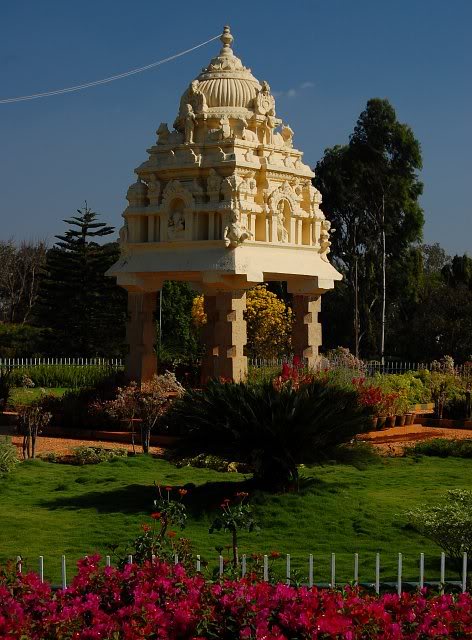
There were two more Kempe Gowdas after Kempe Gowda the First. Kempe Gowda the Second is credited with building four towers in four directions of the city, including the landmark tower in Lalbagh.
His son, Kempe Gowda the Third, later moved his capital to the nearby town of Magadi following an invasion led by Ranadulla Khan of the Bijapur Sultanate’s army.
Alternate Story About the Origin of the Name Bengaluru
This short story about Kempe Gowda was obtained from Wikipedia and other public-domain sources. There are different versions about the origin of the name Bengaluru as well as about who founded the city. According to one account, the twelfth-century Hoysala king Veera Ballala II was on a hunting expedition when he lost his way in a forest.
Tired and hungry, he came across a poor old woman who served him boiled beans. The grateful king is said to have named the place benda-kaal-uru, literally meaning “town of boiled beans”, which eventually evolved into Bengaluru. There is also uncertainty about Kempe Gowda’s date of birth. Some accounts place his birth in April, while others place it in June. The state government decided to observe June 27 as his birth anniversary, and this episode was published to coincide with Kempegowda Jayanti.
Statue of Presperity,Bengaluru Airport
The 108-foot bronze effigy of Nadaprabhu Hiriya Kempe Gowda stands prominently within a 23-acre theme park on the approach to Kempegowda International Airport (KIA). Sculpted by the renowned Ram V. Sutar—who also designed the Statue of Unity—the monument holds a World Book of Records distinction as the first and tallest bronze statue of a city founder. Integrating the statue into a piece focused on modern Bengaluru offers a clear contrast between the city’s cutting-edge aviation hub and its sixteenth-century roots. Describing the transition from KIA’s bamboo-lined, garden-themed Terminal 2 to the towering bronze figure captures the city’s intent to anchor rapid technological expansion in civic heritage.
About Baalgatha
Baalgatha is a podcast featuring stories for children, including stories from Indian folklore, mythology, history and traditional literature. Through these stories, young listeners can discover characters, cultures, historical figures and ideas from India and around the world.
How to Subscribe or Leave a Review
Did you like this short profile of Kempe Gowda the First? We would love to hear your feedback.
You can write to us at [email protected], or leave a review on your favourite podcasting website or app.
Baalgatha is available on several podcasting platforms. Visit Baalgatha.com or the gaathastory Subscribe page to find out how you can listen and subscribe.
Baalgatha on Telegram
Now, introducing the Baalgatha Channel on Telegram. Subscribe to receive updates whenever a new story is published.
Image Credit
[Kempe Gowda Tower image]
Image of Kempe Gowda Tower Park in Bengaluru. Image courtesy of Wikimapia.
Additional image source: Wikimedia Commons, obtained under a Creative Commons CC BY-SA 3.0 licence.
Enjoyed this Baalgatha story? Share it with a young listener who would enjoy learning about the history and stories behind Bengaluru.
Last updated: September 29, 2026 at 8:41 am